Organizada por el CEIC/IKI  – UPV/EHU, por el Research Committee Social Classes and Social Movements – ISA RC47 (Antimo Farro) y el Research Committe Social Movements, Collective Action and Social Change – ISA RC48 (Benjamín Tejerina).
Pinche aquí para descargar las ACTAS de la Conferencia / Click here to download the Conference PROCEEDINGS

Thursday, February 9

Session 1 ARAB SPRING I
Chair: Antimo Farro
(9:45-11:15)

  • Musleh, Abeer (Heller School for Social Policy and Management, Brandeis University)
    Mobilizing during the Arab Revolutions: Palestinian Youth Speak for Themselves
  • Khosrokhavar, Farhad (CADIS)
    Arab Spring Mobilizations
  • Garduño García, Moisés (Universidad Autónoma de Madrid)
    Iconography and Contestatory Language in the Arab Protest
  • Desrues, Thierry (IESA-CSIC)
    The 20th February Movement: Collective Action and Political Responses in Morocco

Session 2. ARAB SPRING II
Chair: Ignacia Perugorria
(11:45-13:15)

  • Perna, Stefania (University of Reading)
    Social Media and New Technologies in Egypt and Tunisia: Two Examples of Innovative Forms of Democratization
  • Esu, Aide & Maddanu, Simone (Università degli Studi di Cagliari & CADIS-EHESS)
    The Controlled Heteropia: Urban Ethnography among Tunisian Migrants connected to Arab Spring
  • Gómez Martín, Carmen (EHESS)
    Gdeim Izik. A Change in the Struggle Strategies of the Sahrawi Population

Session 3A. INTERNATIONALIZATION OF PROTESTS
Chair: Amparo Lasén
(15:30-17:00)

  • Baumgarten, Britta (CIES-ISCTE, Universidade de Lisboa)
    Espanha, Grecia, Irlanda, Portugal! A nossa luta é internacional! The Portuguese Mobilizations around the Economic Crisis and their Relationship to Other Contemporary Protests
  • Langman, Lauren (Loyola University)
    Occupy: New New Social Movement
  • Grinberg, Lev Luis (Ben Gurion University)
    The Israeli Mix of Europe and the Middle East: Collective Identity, Mobilization and Socio-Political Context of the J-14 Movement
  • Sotirakopoulos, Nikos (University of Kent)
    The Notion of the Multitude and Lessons from the Present Cycle of Struggles: The Case of Greece

Session 3B. YOUTH AND STUDENT MOBILIZATIONS
Chair: Elena Casado
(15:30-17:00)

  •  Fernández González, Joseba (UPV-EHU)
    The New Wave of Student Mobilizations in Europe Explained as a Fordist-Posfordist Transition
  • Zamponi, Lorenzo (European University Institute)
    Precarious Present, Uncertain Future: Multiple Dimensions of Precarity as a Symbolic Tool and Resource in the Italian University Mobilization
  • Rebughini, Paola (University of Milan)
    Avatars of Emancipation: From Critique to Indignation?

Session 4A. EMOTIONS AND AFFECTS IN SOCIAL Chair: Ybon Le Bot(17:30-19:30)

  •  Langman, Lauren & Benski, Tova (Loyola University & Tel Aviv University)
    The Effects of Affects: Democratic Social Movements and their Visions
  • Lasén, Amparo & Casado, Elena (Universidad Complutense de Madrid)
    Exhibitionism, Affects and Choreographies: Redefining Public Space from Women’s Movements among Others
  • Nomiya, Daishiro (Sophia University)
    Transforming the Ominous into Happiness: How Antinuclear Drive Was Tamed in the Post-war Japan?
  • Bataille, Philippe (CADIS)
    Au sujet du corps, le corps du Sujet

Session 4B. RETHINKING SOCIAL MOVEMENTS Chair: Paola Rebughini (17:30-19:30)

  • Toscano, Emanuele (Sapienza-Università di Roma)
    The space of movements: An interpretative frame
  • Martínez, Zesar, Casado, Beariz & Ibarra, Pedro (UPVEHU)
    Aproximación a los movimientos sociales como sujetos de Emancipación
  • Schlembach, Raphael (University of Salford)
    Social Movements in Post-Political Society: Prefiguration, Deliberation and Consensus
  • Anguelovski, Isabelle (Universitat Autónoma de Barcelona & MIT)
    ‘Environment and health, yes… but for other reasons’: Asserting Control, Sovereignty, and Transgression in Barcelona

Friday, February 10

Session 5. 15M AND ‘INDIGNADO’ MOBILIZATIONS I: CONTINUITIES AND DISCONTINUITIES
Chair: Dai Nomiya
(9:00-11:00)

  • Alberich Nistal, Tomás (Universidad Complutense of Madrid)
    Antecedents, Changes and Challenges of the New Sociopolitical Movements in Spain and the 15M Movement.
  • Tejerina, Benjamín & Perugorría, Ignacia (UPV/EHU & Rutgers University)
    Continuities and Discontinuities in Recent Social Mobilizations. From New Social Movements to the Alter-Global Mobilizations and the 15M
  • Fernández García, Manuel (IESA-CSIC)
    Emerging Forms of Political Protest as Participation: The Political Space of 15M Movement
  • Farro , Antimo L. (Sapienza-Università di Roma & CADIS)
    XXI Century Social Movements. New Issues and New Questions

Session 6. 15M AND ‘INDIGNADO’ MOBILIZATIONSII: LEARNING PROCESSES
Chair: Ignacia Perugorria
(11:30-13:30)

  • Rivero Jiménez, Borja (Universidad de Extremadura)
    The Assemblies of 15th May Movement in Cáceres: An Example of Democracy School, a Road to Dialogic Society
  • Romanos, Eduardo (Universidad Pública de Navarra)
    Collective Learning Processes within Social Movements: Some Insights into the Spanish 15M Movement
  • Nez, Héloïse (Université Paris 13)
    Among Militants and Deliberative Laboratories: The Indignados
  • Calvo, Kerman (Universidad de Salamanca)
    Fighting for a Voice: the 15M Movement in Spain

Session 7A. MEDIA AND SOCIAL MOVEMENTS
Chair: Emanuele Toscazo
(15:30-17:00)

  • Hyun, Jeong-Im (Sogang University)
    What Really Matters in Creating Mass Mobilization: Classical Organization or New Social Media? A Comparative Case Study of the Mass Mobilization Process in France and South Korea
  • Vicari, Stefania (University of Leicester)
    Protests for Global Change on Twitter: The Case of #15oct in ItalyPROGRAM
  • Del Amo, Ion Andoni, Diaux, Jason & Letamendía, Arkaitz (UPV-EHU)
    Protest Politics Through Music in the Basque Country. The Spread of the Lip Dub as a New Form of Collective Action
  • Del Val, Fernán (Universidad Complutense)
    The Sound of the Transition: Youth, Politics and Popular Music in Spain

Session 7B. IDENTITY AND PERFORMATIVITY
Chair: Tova Benski
(15:30-17:00)

  • Tominaga, Kyoko (University of Tokyo)
    A Study of Movement Identity on Protest Events: The case of The Protest Against the 2008 Hokkaido Toyako G8 Summit
  • Everhart, Katherine (Vanderbilt University)
    Ocup(arte)!: Cultural Engagement in The University of Puerto Rico Student Movement, 2010
  • Martínez, Miguel A. (Universidad Complutense de Madrid)
    Cumulative Chains of Activist Exchanges: the Occupation of Squares and the Squatting of Buildings

Session 8A. NEOLIBERALISM AND GLOBALIZATION
Chair: Simone Maddanu
(17:30-19:00)

  • Xambó Olmos, Rafael & Ginés Sánchez, Xavier (Universitat de València)
    From the Save Movements to the Live Ones. An Analytical Approach to the Evolution of Social Movements in Valencia in the Last Two Decades
  • Rosenhek, Zeev & Shalev, Michael (Open University of Israel & Hebrew University of Jerusalem)
    Class, Generation and Social Protest. The Summer of Discontent in Israel
  • Bizberg, Ilan (El Colegio de México)
    Social Movements, Civic Society and Globalization in Latin America
  • Le Bot, Yvon (CADIS)
    The Emergence of the Migrant Subject. A Sociological Interpretation of the Latino Movement in the United States
La figura de la víctima

La figura de la víctima

21-22/12/2012 Bizkaia Aretoa, UPV-EHU Proyecto Mundo(s) de Víctimas

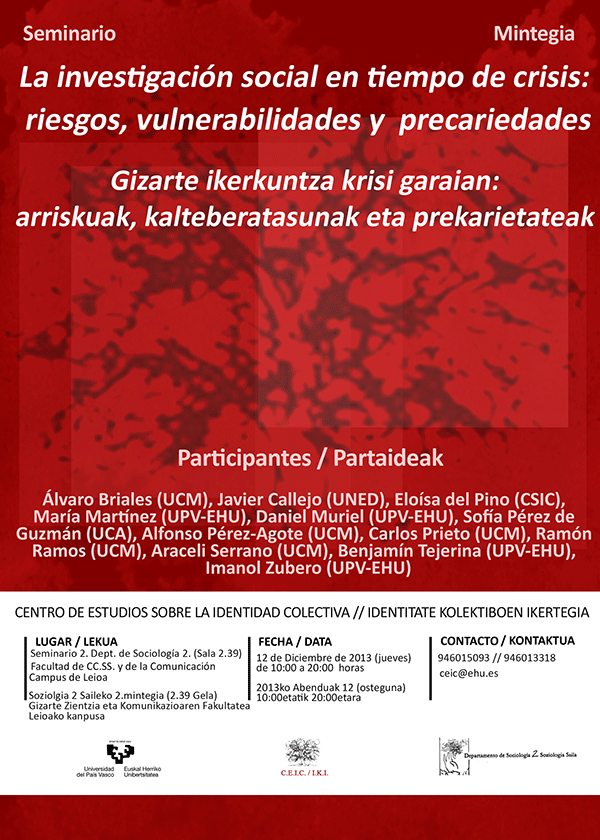
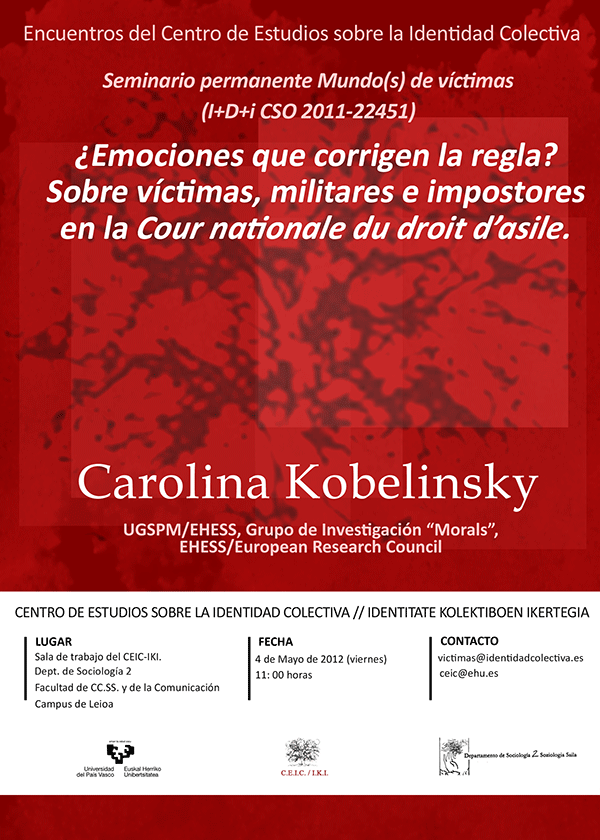
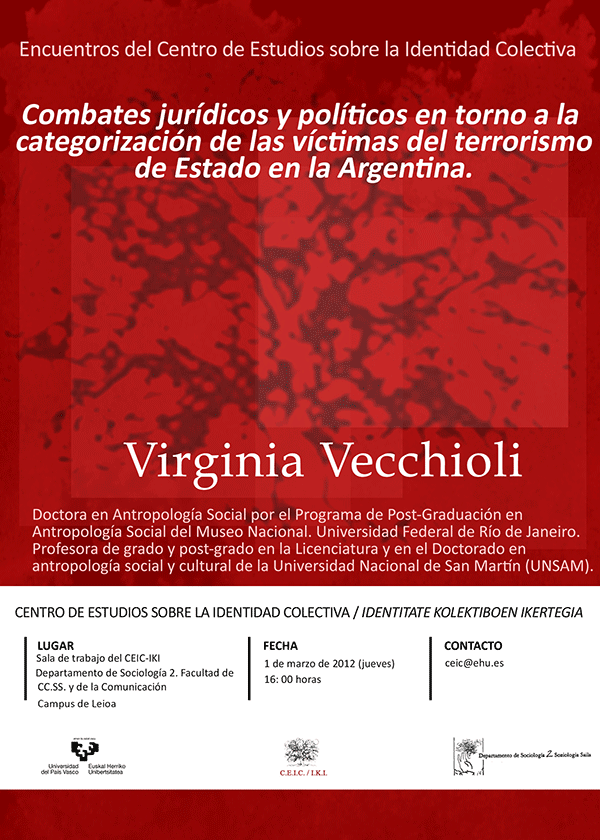
Entre otros, han participado: Silvia Rodríguez Maeso, Tatiana Moura y António Sousa Ribeiro, del CES de Coimbra; Fabiana Rousseaux, de la secretaría de derechos humanos de la nación, Argentina; Sandrine Revet, del CERI-Sciences Po, París; David Casado, de la Universidad de Vigo; y Lupicinio Iñiguez, de la Universidad Autónoma de Barcelona. Por el CEIC, participaron Gabriel Gatti, Daniel Muriel y David Gómez, Ignacio Irazuzta y Beatriz Cavia.

Situaciones de vulnerabilidad en la sociedad contemporánea

Situaciones de vulnerabilidad en la sociedad contemporánea

11-12/11/2010 Observatorio Vasco de la Juventud CEIC

Este seminario internacional nace de una preocupación más amplia, que desde el CEIC venimos realizando en los últimos años, en torno a los conceptos de precariedad vital, por un lado, y vulnerabilidad, por el otro, en las sociedades contemporáneas. Este seminario constituye un momento más en ese intento de encarar aspectos teóricos y empíricos de unos conceptos para los que carecemos de definición sistemática.

Así mismo, constituye objetivo de este seminario avanzar en la construcción de una red estable de investigación, financiada en 2010 por la Dirección de Política Científica del Departamento de Universidad e Investigación del Gobierno Vasco. Dicha red se desarrolla junto al GTM (Genre, travail, mobilités) del CNRS, en Francia, grupo con el que el CEIC tiene una larga trayectoria de trabajo conjunto; y con el GRESCO de la UCM, con el que venimos investigando en los últimos años. Esta red pretende traducirse en un proyecto de investigación comparativo sobre identidad colectiva y precariedad laboral, proyecto al que se intentará dar formar durante el desarrollo de este seminario.

El programa del seminario se construye, así, en base a este doble objetivo: por un lado, se realizarán una serie de sesiones que permitirán avanzar en la definición de los conceptos de precariedad y vulnerabilidad desde diferentes perspectivas de abordaje; y, por otro lado, se pretende avanzar en la definición de un proyecto de investigación conjunto en base a la puesta en común desarrollada durante el seminario.

Jueves, Noviembre 11

9h 30
PRESENTACIÓN DEL SEMINARIO: SITUACIONES DE VULNERABILIDAD EN LA SOCIEDAD CONTEMPORÁNEA
Benjamín Tejerina, Gabriel Gatti y Beatriz Cavia

10h – 11h 45
SESIÓN I. Precariedad y vulnerabilidad del “otro”: la ciudadanía en cuestión
Coordina: Gabriel Gatti

  • Jane Freedman, GTM – CRESPPA, Universidad de París 8 y Universidad de París 10
    PRECARIOUSNESS AND VULNERABILITY AMONGST ASYLUM-SEEKING AND REFUGEE WOMEN IN EUROPE
  • Ana Devic, Universidad de Glasgow y Universidad de Nori Sad
    ‘NEW ASSIMILATIONISM’ AND TRANSNATIONAL MARGINALITY IN EUROPEAN CITIZENSHIP REGIMES: MIGRATIONS AND EXPULSIONS OF THE ROMA

12h 15 – 14h 00
SESSION II. Precariedad y vulnerabilidad de los espacios
Coordina: Benjamín Tejerina

  • Margarita Barañano, Universidad Complutense de Madrid
    PRECARIEDADES URBANAS: EL CASO DE LOS BARRIOS MULTICULTURALES
  • Stefania Barca, CES – Coimbra
    TOXIC COMMUNITIES. PETROCHEMICAL CONTAMINATION AND THE STRUGGLE FOR ENVIRONMENTAL JUSTICE IN THE ITALIAN SOUTH

16h 00 – 19h 30
SESSION III. Precariedad y vulnerabilidad del trabajo y en el empleo
Coordina: Beatriz Cavia

  • Eduardo Crespo, Universidad Complutense de Madrid
    LA PSICOLOGIZACIÓN DEL TRABAJO
  • Sabine Fortino, GTM – CRESPPA, Universidad de París 8 y Universidad de París 10
    VULNERABILITÉ, PÉNIBILITÉ ET MAL-ÊTRE SOCIAL AU TRAVAIL EN FRANCE: LE TRAVAIL MODERNE EN QUESTION
  • Amparo Serrano, Universidad Complutense de Madrid
    INGENIERÍAS DE LA SUBJETIVIDAD: EL CASO DE LA ORIENTACIÓN PARA EL DESEMPLEO

Viernes, Noviembre 12

9h 30 – 10h 45
MESA REDONDA. Propuestas de abordaje de la precariedad y la vulnerabilidad desde el trabajo del CEIC
Modera: María Martínez

  • Daniel Muriel, CEIC – IKI
    EL PATRIMONIO CULTURAL COMO MECANISMO CONTEMPORÁNEO DE CONTROL/INDUCCIÓN DE LA VULNERABILIDAD IDENTITARIA
  • Diego Carbajo, CEIC – IKI
    EL CONCEPTO DE PRECARIEDAD/PRECARIZACIÓN EN LAS TRANSICIONES RESIDENCIALES DE LOS JÓVENES DE LA CAPV
  • David Gómez, CEIC – IKI
    LA SITUACIÓN EN LA INSERCIÓN PERMANENTE

11h 15 – 14h
TALLER DE INVESTIGACIÓN. Hacia un proyecto de investigación conjunto
Modera: Beatriz Cavia

Lo que la precariedad nos dice acerca de lo social. Diálogos franco-españoles

Lo que la precariedad nos dice acerca de lo social. Diálogos franco-españoles

20-21/11/2008 CNRS (Centre National de la Recherche Scientifique) CEIC

Coloquio Internacional en Ciencias Sociales «Lo que la precariedad nos dice acerca de lo social. Diálogos franco-  españoles”. París, 20 y 21 de noviembre del 2008. Organizado por el CEIC (Benjamín Tejerina y Beatriz Cavia) en  colaboración con Sabine Fortino y José Calderón del GTM (Genre, travail, mobilités) de la CNRS (Centre National de  la  Recherche Scientifique).